Irene Simmons Photograph
June 1972
Link to this page: undefined/image/ecabc42a-ff7a-47d2-ba19-ebf3210a78fb

Notes
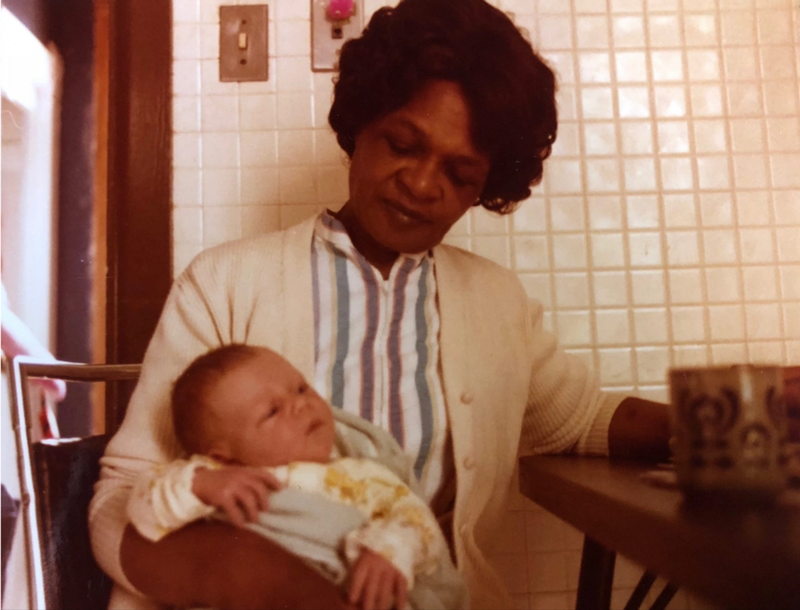
This is Irene Simmons in 1979, still on the job 26 years later, holding my son Murphy.
Like Alfonso Cuarón in Romá, my parents entrusted much of my childcare to a series of live-in housekeepers — young Irish women when i was very young, but from five or six forward Irene Simmons took on the role of alter-parent. My parents were comfortably middle class, which in 1950s NY meant they could afford full-time "help." Since both mom and dad worked it seemed "justified." Cuarón wrote and directed an entire movie — Roma — in an attempt to pay homage to "Cleo, the woman who migrated from her poor village to Mexico City to find work. Similarly Irene was part of the post-war migration of African-Americans from the south to the industrial north.
Cuaron's movie is gorgeous but his understanding of Cleo seems relatively one- dimensional; i.e. no matter how much he basks in her love and appreciates her importance to him, Cuaron's portrayal of Cleo is muted by the blinders of class and privilege.
Irene stayed with my parents for over 30 years, moving into a flat of her own when i was 16. That means Irene was a central part of my life during the civil rights and black liberation eras of the 50s, 60s and 70s. But she virtually never said anything about what was happening or how she felt about it. The only time I remember Irene directly acknowledging the issue of race, was when i was in primary school and she argued against my sister calling a black poodle Licorice, saying it was wrong to define a living being by their color.
Later, when I came home from college, full of my privileged white-boy wokeness, Irene responded with what in retrospect was a weary knowledge of how limited my understanding of her experience actually was. I think she was happy to see me trying to do something positive to right the wrongs so deeply embedded in our society, but I'm mortified to realize that no matter how much i appreciated Irene's unqualified love, I never pushed to break our conversations out of the pre- defined boundaries set by my parents and the cultural milieu we lived in.
My parents weren't cracker racist, they were liberal racist, acknowledging some of the worst elements of racial oppression, but fundamentally accepting the status quo and treating Irene as a cipher whose only visible purpose in life was to make theirs easier. At the least I felt guilty enough to empty my bank account of bar mitzvah and birthday money — several thousand dollars — and gave it all to Irene when i turned 21. But far from patting myself on the back, I have to own up to the fact that I must have absorbed my parents outlook far more deeply than i've wanted to admit. If not, I would have worked much harder, a whole lot harder, at being interested in the contours and realities of Irene's life beyond the borders of my parents home.
Every upper-middle class white family I know, who had African-American housekeepers considered the women to be "members of the family" — which invariably was a completely self-serving trope used to mask the uncomfortable reality — The Roma Problem